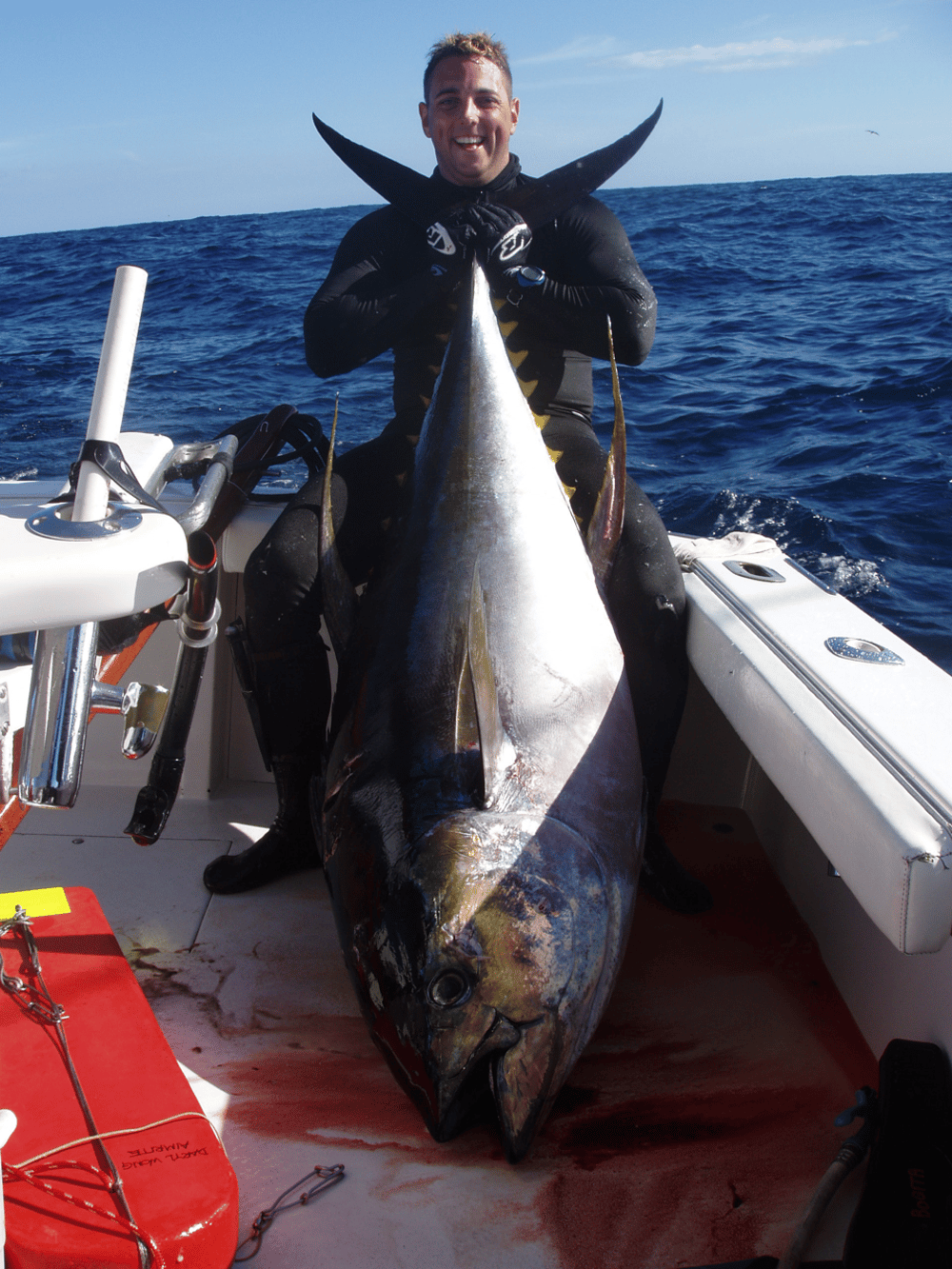
Freediving is the sport of breath-hold diving. A freediver relies on a single breath of air to explore the undersea world rather than a bulky, self-contained underwater breathing apparatus or “SCUBA." Moving gracefully without wasting energy, the freediver descends and becomes more adapted to the aquatic environment with repetitive dives. Freedivers view the underwater world from the surface of the water as well as the depths. It is a natural form of diving. The brief time spent underwater on a freedive is a rich and intensely beautiful experience. Gracefully slipping underwater, hearing only their heart beat, freedivers feel a pure connection to the ocean. Freediving is a water adventure that allows enthusiastic men and women to experience the sights, sounds and challenges of the most natural of underwater experiences.
Fish respond to freedivers much better than scuba divers, thus allowing the freediver a closer and more intimate experience with marine life. With no bubbles and slow, graceful movements, the freediver resembles an aquatic mammal. The vast majority of freedivers claim to be able to approach and interact with fish much more intimately than when using scuba equipment. Freediving is a way to visit this fantastic environment with nothing but a deep breath of air. These brief underwater encounters, whether 30 seconds or a few minutes, make freedivers feel as though they are not just visitors, but rather members of the sea. Some freedivers can reach depths below 100 feet. Freediving is about the comfort and exploration of the ocean realm for recreation, spearfishing, competition, or personal discovery. To freedive is not to compete with someone else; it is to compete with one’s self. Freediving is a journey--an exploration of one's capabilities and potentials. Freediving is a calm, peaceful and relatively safe activity. It can, however, be a potentially dangerous one depending on individual physiology and state of mind.
Several factors contribute to a deep, long dive such as comfort, conditioning, confidence, current, equipment, and visibility. Relaxation is the factor that affects the duration and quality of a freedive the most. Training in an aerobic heart range will give the freediver distinct advantages in both depth potential and duration of your comfort zone for each descent, but freediving is far more about mindset, technique, and the ability to relax than actual fitness or strength. When the freediver goes underwater, the pressure of the water increases as the freediver goes deeper. This increasing pressure squeezes several air spaces within the freediver as well as the equipment used. This means that during a freedive descent, the freediver's lung volume and air spaces in the mask and wetsuit are reduced in proportion to the pressure acting on them.
Modern technology has enhanced freediving equipment. A freediver no longer needs to kick hard to descend to a fixed neutral depth, remain negative throughout the bottom portion of the dive, or fight to ascend to the surface at the most critical time of a breath-hold. Freedivers use specialty fins known as long-blade fins, some of which are made of carbon fiber and other materials that were not available before. They also use compact or low-volume face masks, streamlined snorkels, rubber weight belts and wetsuits of various thicknesses and materials that aid in their movement through the water. The fins operate as extensions of the freediver’s legs. Freedivers depend on special European-style, long, flexible fins with lots of "memory" in their resilient blades. The wetsuit is the freediver's second skin as it helps keep the body warm while in the water. Wetsuits are always used on freedives even in the warmest water, because anything below 98.6 degrees Farenheit will leach energy from the diver over a period of time. Wetsuits, when used in conjunction with a weight belt, will aid the diver on the descent because the increase of pressure shrinks the tiny air spaces in the suit making it less buoyant and allowing the led weights to take over. The rubber weight belt is put on tight at the surface and stays snug to the body as it is compressed with increasing depth and pressure, unlike nylon belts which lack this elasticity. Undistracted by a shifting weight belt, the diver is able to glide to the bottom with minimal effort, conserving energy and oxygen. The reverse happens on the way back to the surface as the diver becomes more buoyant. The mask enables the freediver to see this underwater environment clearly by creating an air space between the eyes and the water. To equalize, the free diver must simply blow a small amount of air out of their nose into the mask, therefore more air can be conserved with a lower volume mask. A mask with a nose pocket is also important for freediving as it allows the nostrils to be pinched off while equalizing the sinuses at increased depth and pressure. The appropriate equipment is vital to a successful freedive, but it is proper mental training, technique and physical conditioning that determine the depths he or she can safely achieve.
Advanced training and education is mandatory to understand proper breathing techniques, equalizing, underwater motions, and a necessary buddy system, including freediver rescue. Advanced freedivers conducting repetitive deep dives with long periods underwater and little recovery time at the surface can develop decompression sickness from an accumulation of nitrogen in the body, but most recreational freedivers do not come close to suffering from this phenomenon.
Freedivers who pit themselves against the elements of the sea with one breath of air must channel stress properly while remaining cognizant of the risks involved and continually respecting the ocean and ocean life. These things considered, freediving can be an incredibly beautiful journey filled with extreme and otherwise unattainable encounters with sea life which can significantly enhance a diver’s love for the ocean.